
Many people notice that their acne worsens in summer or during seasonal changes. While the root cause of acne is still linked to inflammation and abnormal keratinization within the pilosebaceous unit, environmental factors—especially seasonal shifts—can amplify certain triggers. This creates what we commonly perceive as “seasonal breakouts.”
Below is a dermatology-based explanation of how summer and winter acne differ in their mechanisms.
1. Summer Acne: “Oil Overproduction + Bacterial Growth” Leading to Inflammation
1) Heat increases sebaceous gland activity
Studies show that sebum production rises with temperature.
Elevated environmental heat and increased physical activity in summer stimulate the sebaceous glands.
→ This results in oily skin, clogged pores, blackheads, whiteheads, and comedones.
2) Humidity and sweat promote microbial growth
Sweat mixes with sebum and changes the skin’s surface microenvironment.
Warm, humid conditions support the growth of Cutibacterium acnes and certain Staphylococcus species.
→ This makes inflammatory papules and pustules more common.
3) UV exposure weakens the skin barrier
UV radiation disrupts barrier lipids, creates free radicals, and increases micro-inflammation.
→ Follicles become more reactive, accelerating acne inflammation.
4) Sunscreens and cosmetics may add to occlusion
Heavy or non–sweat-resistant products can mix with excess oil, contributing to pore blockage.
Typical summer presentation:
Oily T-zone breakouts, sweat-triggered flare-ups, and prominent red, inflamed acne lesions.
2. Winter Acne: “Dehydration + Barrier Damage” Leading to Blockage and Deep Breakouts
Winter acne is quite different. It’s usually a secondary result of a weakened skin barrier rather than excess oil.
1) Cold air + indoor heating → increased transepidermal water loss
Low humidity and heated indoor environments reduce skin moisture.
Barrier lipids become disrupted, and the stratum corneum loses hydration.
→ This makes the skin more sensitive and prone to micro-inflammation.
2) “Dryness-induced blockage” becomes common
Dryness causes uneven keratinization and slower cell turnover.
Dead skin cells accumulate and narrow the pore opening.
→ Even with less oil, blockages and comedones form easily.
3) Compensatory sebum production
Dehydrated skin triggers the sebaceous glands to produce more oil in an attempt to protect the surface.
This oil tends to be thicker and harder to discharge.
→ Creating the well-known “dry outside, oily inside” condition.
4) Improper winter skincare
Over-cleansing or using occlusive, comedogenic moisturizers can worsen obstruction.
Typical winter presentation:
Chin and mouth-area closed comedones, dry yet congested skin, and recurring deep, cystic-like blemishes.
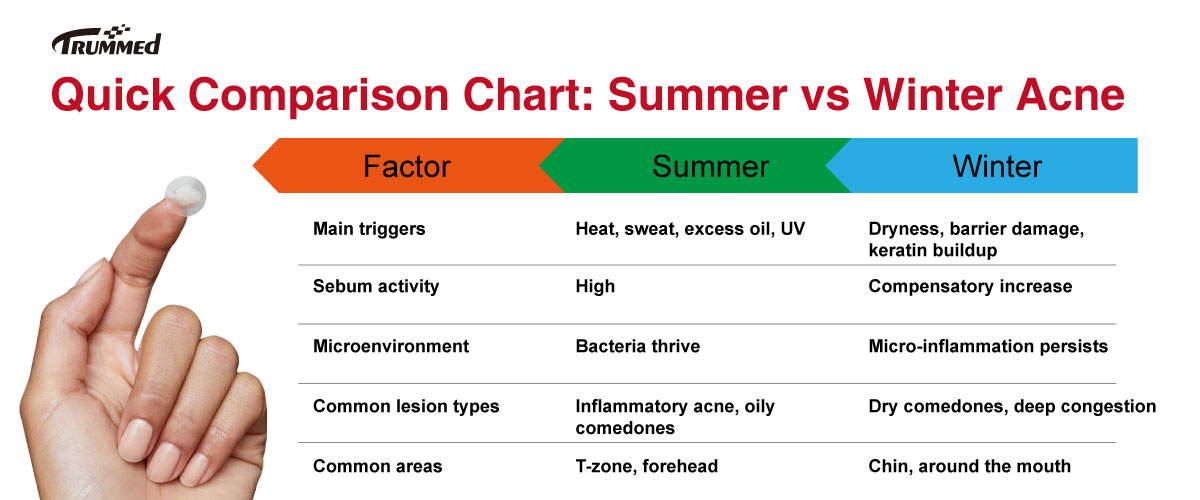
3. Why Does Seasonal Acne Happen?
Skin Microbiome + Barrier Changes
Season alone doesn’t cause acne, but it significantly alters the skin environment and microbiome balance, influencing the four core acne factors:
1. Sebum production
2. Follicular hyperkeratinization
3. Microbial activity (C. acnes, Staphylococcus, etc.)
4. Inflammatory response levels
Summer amplifies “oil + bacteria”,
while winter amplifies “dryness + keratin buildup.”
This explains why many people break out in a predictable seasonal pattern.
4. Conclusion
Seasonal change is not a direct cause of acne, but it modifies skin oil levels, hydration, and the microbiome—amplifying the mechanisms that lead to breakouts.
Different seasons bring different skin concerns, making targeted acne-care products even more necessary. For example:
*In summer, lightweight, oil-absorbing and pore-clearing pimple patches help quickly remove excess sebum and reduce redness.
*In winter, soothing and barrier-repairing pimple patches help lock in moisture while calming inflammation.
Within the same pimple-patch category, product lines can be expanded based on seasonal differences to offer more tailored care solutions.