
Waterproof? Maybe. Swim-proof? That's a different question.
Many acne patches today are marketed as “waterproof,” leading people to assume they can wear them while swimming without any issues. But if you've ever had a patch peel off halfway through a pool session, you already know the reality is more complicated.
The question isn't simply whether acne patches resist water.
The real question is:
Can an acne patch stay attached under prolonged water exposure, movement, sweat, oil, and pressure?
For consumers, that difference affects user experience. For brands and manufacturers, it affects product performance expectations.
Swimming Creates a Completely Different Challenge
Most acne patches are made with hydrocolloid materials combined with medical-grade adhesive layers. Hydrocolloids naturally offer some water resistance, which is why patches usually work well during:
· Face washing
· Showering
· Light sweating
· Daily outdoor activities
But swimming introduces conditions that ordinary daily use doesn't:
· Long periods underwater
· Pool chemicals or salt water
· Continuous water flow and pressure
· Facial movement
· Sweat and skin oil buildup
· Sunscreen residue
Under these conditions, patches don't usually fail suddenly.
The edges fail first.
Once water starts entering around lifted edges, adhesion drops rapidly.
This is why two patches that both claim “waterproof” may perform very differently in real-world swimming situations.
The Hidden Factors Behind Swim Performance
Consumers often look for “waterproof” labels, but manufacturers know performance depends on much more.
1. Edge Design Matters More Than Most People Realize
Ultra-thin tapered edges create smoother transitions between patch and skin.
Thick or abrupt edges create tiny lifting points where water can begin to penetrate.
Even slight edge lifting becomes much more noticeable during swimming.
2. Adhesive Water Resistance Is Critical
Not all adhesive systems behave the same in water.
Some adhesives maintain their holding strength after prolonged moisture exposure, while others gradually soften or lose adhesion.
Swimming quickly reveals these differences.
3. Absorption Changes Patch Behavior
Hydrocolloid materials absorb wound exudate and fluids.
If a pimple has already opened or is producing significant fluid, the patch may swell during wear.
As absorption increases, overall adhesion can change.
4. Placement Matters
The same patch can perform differently depending on where it is worn.
Areas with less movement:
✔ Cheeks
✔ Forehead
More challenging areas:
✘ Nose sides
✘ Chin
✘ Jawline
Constant movement, talking, facial expressions, and friction all affect adhesion.
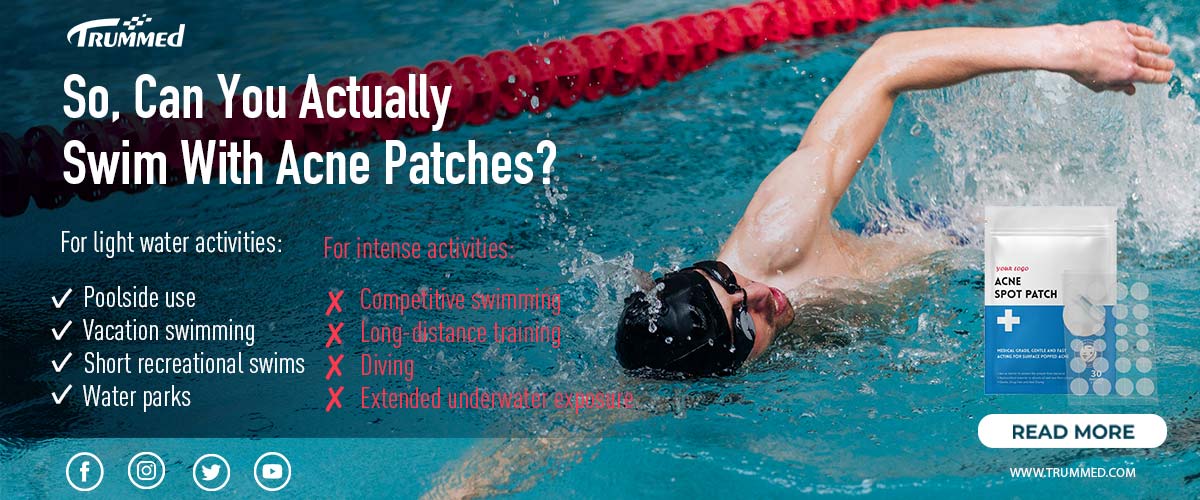
One Small Step Makes a Big Difference
Application technique matters more than many users expect.
Many people apply patches after skincare products and sunscreen.
But oils and skincare residues create a barrier between skin and adhesive.
A better routine:
Clean skin → dry thoroughly → remove excess oil → apply patch → wait 30–60 seconds before water exposure
Sometimes “poor waterproof performance” is actually an application issue rather than a product issue.
Waterproof and Swim-Proof Are Not the Same Thing
The growing demand for active lifestyle skincare products is pushing acne patches beyond traditional overnight use.
Consumers increasingly expect patches to survive workouts, travel, outdoor activities, and even swimming.
As brands continue innovating in edge design, adhesive technology, and hydrocolloid engineering, “swim-friendly” acne patches may become a larger category in the future.
Because when people ask:
"Can I swim with an acne patch?"
They're often asking a bigger question:
"Will it actually stay on when real life happens?"