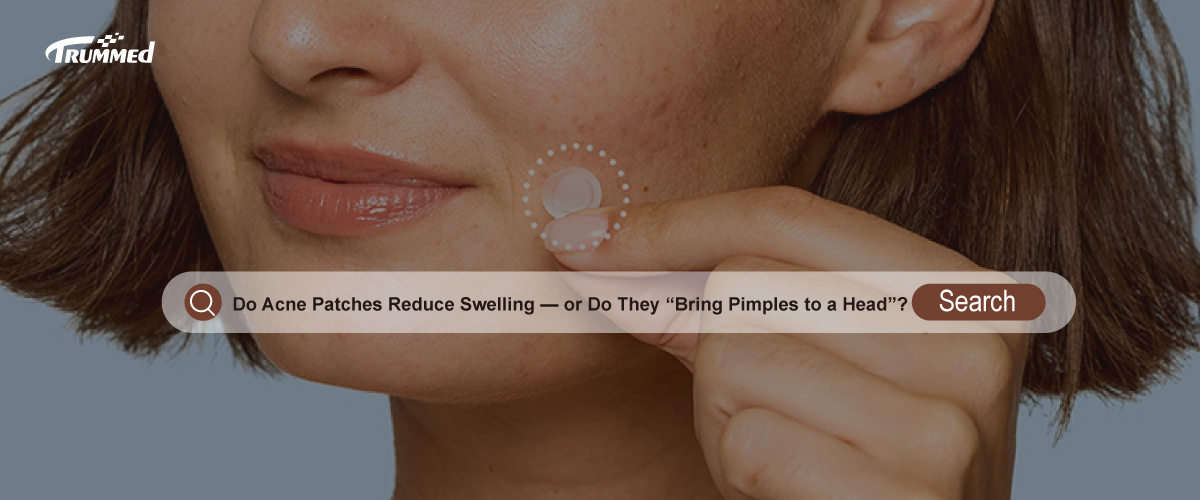
 Many people notice something confusing the first time they use an acne patch:
after applying it, the white center of the pimple seems more visible.
This often leads to a common assumption:
“Are acne patches actually making pimples ripen faster?”
The short answer is no — but the reason why deserves a closer look.
The Bottom Line: Acne Patches Do Not “Create” Whiteheads
Acne patches are not designed to force pimples to mature.
They do not turn closed or deep acne into pustules.
Instead, their role is much more specific:
——They help inflamed or already-draining pimples heal faster,
more cleanly, and with less risk of irritation or scarring.
Why Do Acne Patches Sometimes Look Like They’re “Speeding Things Up”?
The misconception usually comes from a few visible changes after application.
1 The White Spot Becomes More Noticeable
After removing an acne patch, you may see:
l a whiter center on the pimple, or,
l a white residue on the patch itself
This is not newly formed pus.
Inflamed pimples naturally produce fluid, inflammatory exudate, and debris.
Hydrocolloid patches absorb this moisture, drawing it to the surface.
As a result:
l the material becomes more concentrated
l the pimple appears more “developed”
What you’re seeing is absorption, not acceleration.
2 Swelling Goes Down Faster Than Expected
Many users are surprised by how quickly redness and swelling subside.
This happens because acne patches:
l create a stable, moist healing environment
l protect the area from friction, bacteria, and picking
l reduce ongoing irritation
When inflammation is no longer disturbed, the skin can resolve it more efficiently.
3 Pimples Heal Faster Than When Left Alone
Without protection, pimples are often:
l touched unconsciously
l irritated by masks or clothing
l repeatedly scabbed and reopened
An acne patch minimizes these interruptions.
The healing process becomes shorter — which can feel like the patch “did something dramatic.”
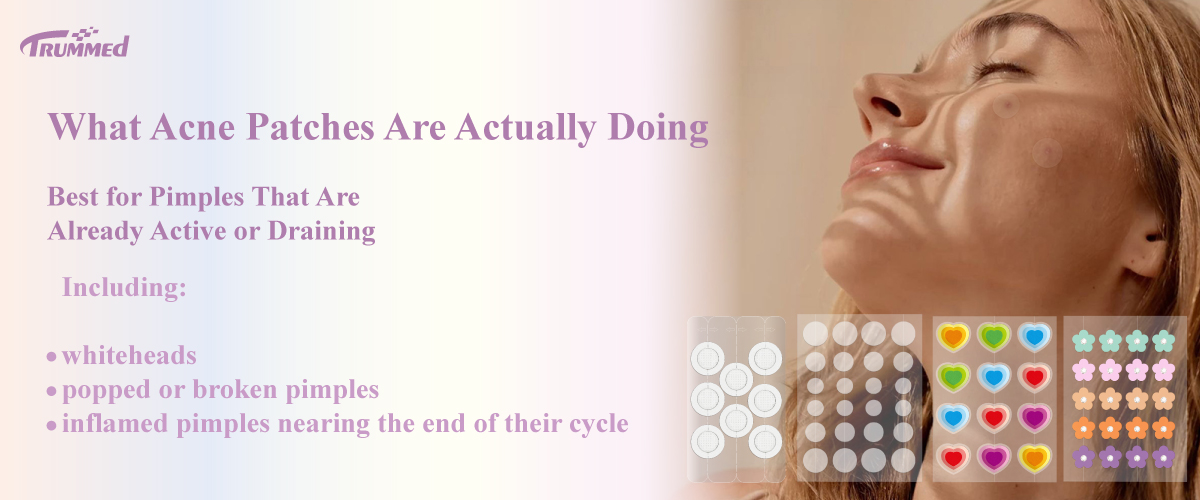
What Acne Patches Are Actually Doing
Acne patches function less like a treatment and more like inflammation management.
Best for Pimples That Are Already Active or Draining
Including:
l whiteheads
l popped or broken pimples
l inflamed pimples nearing the end of their cycle
In these cases, acne patches help by:
l absorbing excess fluid
l reducing bacterial exposure
l preventing secondary infection
l supporting faster flattening and closure
This is where acne patches are most effective.
Not Designed for Deep or Closed Acne
For:
l closed comedones
l deep, hard nodules
Acne patches:
l will not “pull out” deep inflammation
l will not force a pimple to surface
They may still:
l protect the area
l discourage picking
l slightly reduce surface irritation
But limited visible improvement is expected — and normal.
When Acne Patches Are Most Often Mistaken for “Ripening” Pimples
The confusion usually happens when a pimple is already:
l thinning at the surface
l showing a visible center
l leaking clear or cloudy fluid
l recently popped or accidentally broken
At this stage, the pimple is already resolving.
The acne patch simply helps the process finish:
l faster
l cleaner
l with less repeated trauma
Understanding the Real Role of Acne Patches
Acne patches don’t push pimples forward in their lifecycle.
They reduce disruption during the final phase.
They don’t make pimples mature —
they help them end properly.
When used at the right time, acne patches can feel remarkably effective.
When used too early, they may appear to “do nothing.”
Both outcomes are normal — and explainable.
Final Takeaway
If acne patches had a single, accurate description, it would be this:
They are a recovery tool, not a trigger.
A protector, not a catalyst.
Understanding this distinction makes it much easier to use acne patches correctly —
and to set realistic expectations for how they work.