Many people comfort themselves with a familiar thought when acne appears:
“It’s fine. It will heal in a few days.”
From a medical perspective, this is not entirely wrong.
Most acne lesions are indeed reversible inflammatory conditions.
What is often overlooked, however, is a critical distinction:
once acne progresses to scarring, the outcome is no longer something time alone can undo.
Acne and Scars Are Fundamentally Different Conditions
To understand why acne can heal while scars tend to persist, it is essential to distinguish their biological nature.
Acne (acne vulgaris) is an inflammatory disorder of the pilosebaceous unit.
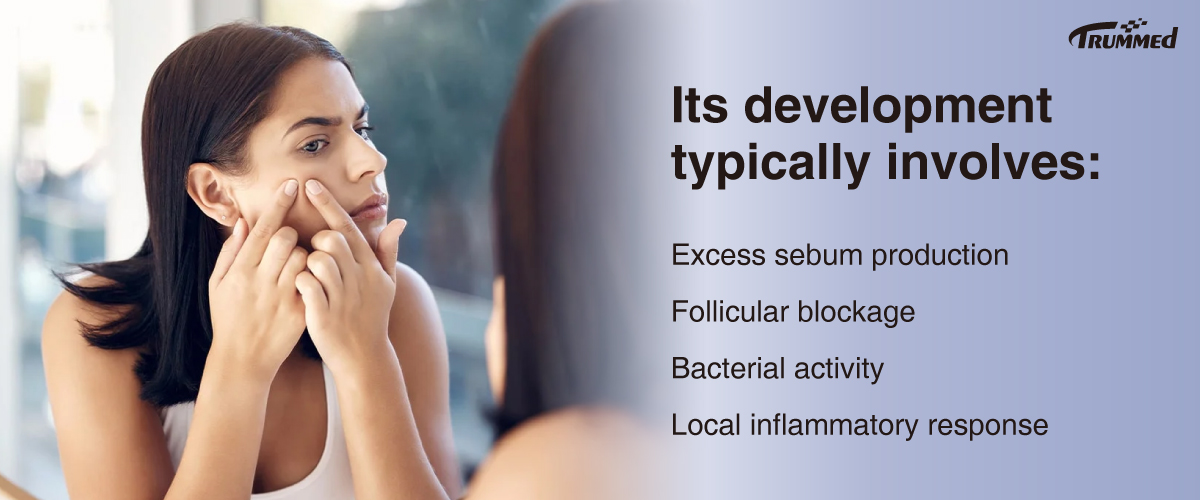
Its development typically involves:
l Excess sebum production
l Follicular blockage
l Bacterial activity
l Local inflammatory response
As long as inflammation is controlled and the dermal structure remains intact, the skin retains the capacity to repair itself and return close to its original state.
Scarring, by contrast, indicates that inflammation or trauma has already caused structural damage to the skin, particularly within the dermis.
This includes disruption of collagen fibers, elastic tissue, and sometimes permanent loss of follicular architecture.
At this stage, the skin is no longer repairing—it is replacing damaged tissue with substitute tissue.
When Does Acne Begin to Transition Into Scarring?
Not all acne lesions lead to scars.
Scarring risk increases significantly under specific conditions:
First, deep or prolonged inflammation.
Red, swollen, and painful lesions often signal inflammation extending into the dermis. The longer this inflammation persists, the greater the likelihood of structural damage.
Second, recurrent inflammation in the same area.
Repeated acne at the same follicle can lead to fibrosis and abnormal tissue remodeling, increasing the risk of permanent textural changes.
Third, secondary injury caused by manual intervention.
Picking, squeezing, or repeated touching introduces mechanical trauma and bacterial spread, compounding inflammatory damage.
Many acne scars are not inevitable.
They develop gradually as a result of how acne is managed during its active stage.
Why Acne Scars Are “Rarely Fully Reversible”
The phrase “not fully reversible” often raises skepticism, so it is important to define what reversibility means in medical terms.
Complete reversal would require:
l Restoration of normal dermal architecture
l Reorganization of collagen fibers to their original alignment
l Regeneration of hair follicles and sebaceous structures
l Normal elasticity, texture, and physiological response
With current medical technology, this level of regeneration is largely unattainable.
When dermal tissue is destroyed, the body prioritizes speed and safety over precision.
The result is a functional replacement, not a true reconstruction of original skin.
This is why scars represent healed tissue—but not healed skin in its original form.
Why Laser and Aesthetic Treatments Can Improve Appearance
This is where confusion often arises.
Laser therapy, radiofrequency, microneedling, and similar treatments can significantly improve the appearance of acne scars by:
l Stimulating new collagen formation
l Improving surface smoothness
l Reducing shadow contrast and textural irregularities
However, these treatments primarily enhance visual and tactile outcomes, not true structural restoration.
Effectiveness also varies widely depending on scar type:
l Post-inflammatory hyperpigmentation (often mistaken for scars) responds well
l Shallow atrophic scars may partially improve with repeated treatment
l Deep or ice-pick scars rarely disappear completely
l Hypertrophic scars may worsen with excessive stimulation
In clinical practice, the preferred terminology is therefore:
“Acne scars can be improved, but rarely restored to pre-injury skin.”
Why Medical Practice Emphasizes Prevention Over Repair
Once scarring occurs, management becomes:
l Long-term
l Costly
l Variable in outcome
l Dependent on individual healing response
In contrast, during the active acne stage, effective intervention focuses on:
l Reducing inflammation
l Minimizing mechanical trauma
l Preventing infection
l Maintaining a stable healing environment
Across dermatology and wound-care disciplines, there is broad consensus:
Preventing structural damage is far more effective than attempting to correct it later.
Conclusion
Acne itself is reversible—but only for a limited time.
Once inflammation progresses into structural damage, scarring becomes difficult to undo.
What truly matters is how acne is managed during this reversible window.
Early, protective actions can significantly reduce the risk of permanent marks, while common “quick fixes” often make things worse.
In the next article, we’ll focus on what actually helps during this critical stage—
and how small, timely interventions can make the difference between acne that heals and scars that last.