 You think you don’t touch your face?
Studies show the average person touches their face over 200 times a day, while 90% believe they “barely ever do.”
This is one of the biggest blind spots behind persistent breakouts.
01 Your unconscious fingers are your acne architects
Every day, your fingers go through a journey:
Phone grease → keyboard dust → door handles → food residue → back to your face.
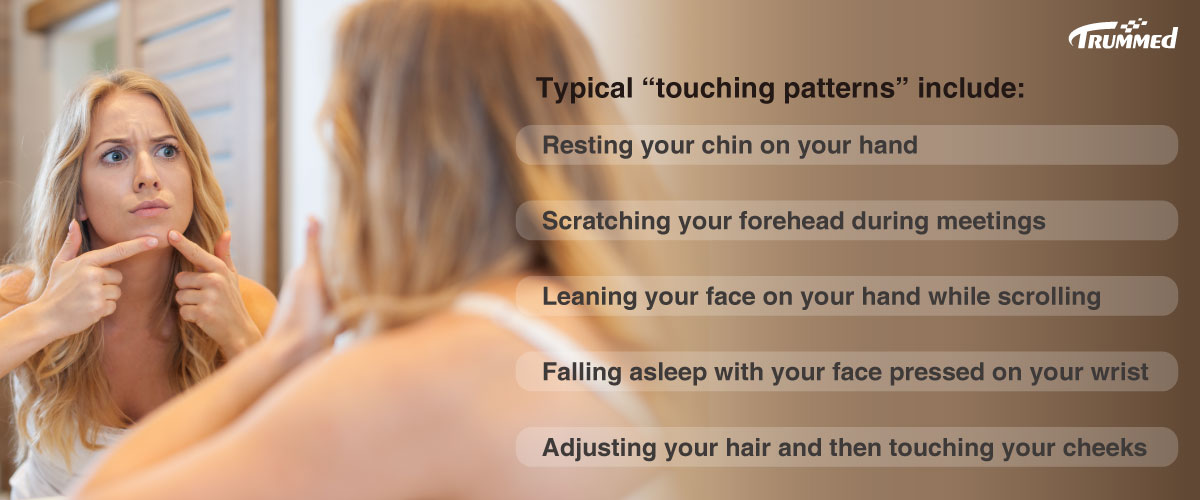
Typical “touching patterns” include:
*Resting your chin on your hand
*Scratching your forehead during meetings
*Leaning your face on your hand while scrolling
*Falling asleep with your face pressed on your wrist
*Adjusting your hair and then touching your cheeks
Each unconscious touch leaves a thin pollution film on the skin surface, accelerating oil oxidation, thickening sebum, and clogging pores.
The most affected areas:
1.Chin triangle (chin–jawline)
2.Side of the face (cheek–temple)
3.Forehead (frown zone)
These regions overlap almost perfectly with today’s most stubborn “recurring acne zones.”
 02 Hands + phone: the most dangerous acne-inducing duo
Why are breakouts getting worse for young people?
Because for the first time in history, we have a continuous 24/7 loop:
Phone screen → fingers → face
Your phone surface holds 10× more bacteria than a public restroom door handle.
Sweat, makeup, hand oils, and dust combine into a microscopic “biofilm” on the screen.
While you scroll, sweat, make calls, and lean your face in—
you’re constantly transferring that biofilm to your cheeks and chin.
This is why so many people suffer from relentless chin acne and cheek-edge breakouts.
03 Why the more you try NOT to touch your face, the more you actually do?
Touching your face is a form of self-soothing behavior.
It spikes during moments like:
1.Anxiety in meetings
2.Hitting a work bottleneck
3.Reading stressful notifications
4.Feeling socially nervous
5.Needing intense concentration
All these emotions trigger the same action:
a hand moving toward your face.
Many pimples aren’t “naturally forming”—
they’re rubbed into existence.
04 How to scientifically reduce finger-induced breakouts
① Raise awareness of “I’m touching my face”
Simply noticing your patterns of touching can cut the habit by 30–40%.
② Clean your phone as often as you clean your hands
Dirty phone → dirty hands → dirty face.
Wipe your screen 1–2 times a day with an alcohol wipe.
③ Manage idle hands during work
Keep fists on the desk instead of propping your chin
Hold cups away from your cheek
Wear headphones to reduce hair-adjusting movements
④ Replace the “touching reflex” with alternative actions
Use a stress ball, fidget toy, or pen spinning.
Behavior replacement dramatically reduces unconscious touching.
05 Product integration
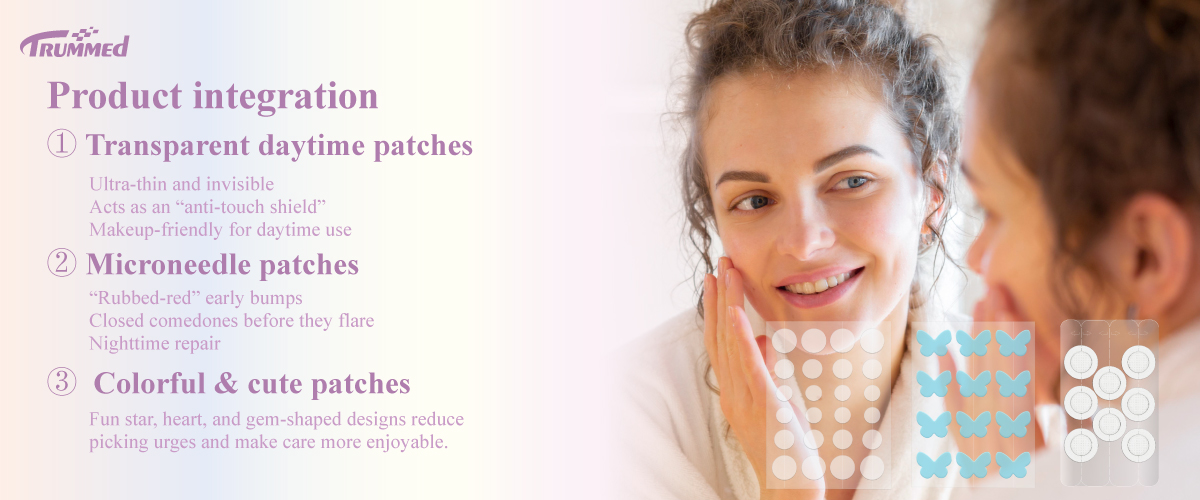
① Transparent daytime patches: a physical anti-touch barrier
Apply transparent pimple patches on zones you tend to touch—
their purpose is not just healing, but preventing contact.
Benefits:
Ultra-thin and invisible
Acts as an “anti-touch shield”
Makeup-friendly for daytime use
② Microneedle patches: rescue early-stage, finger-irritated spots
Microneedles deliver anti-inflammatory ingredients (azelaic acid, niacinamide, peptides) directly into a forming pimple.
Best for:
“Rubbed-red” early bumps
Closed comedones before they flare
Nighttime repair
③ Colorful & cute patches: reduce face-touching through psychology
They send a silent message:
“I’m healing this—don’t touch, don’t poke, don’t ask.”
Fun star, heart, and gem-shaped designs reduce picking urges and make care more enjoyable.
Pimple patches—transparent, colorful, or microneedle—
aren’t just treatments.
They can also become behavior-modifying tools that help break the cycle.
06 Summary
Your fingers are the true culprit behind more breakouts than you think
If oil is the fuel, and stress is the spark,touching your face is the lighter that ignites the breakout.

 You think you don’t touch your face?


