
When we say acne is still “reversible,” we don’t mean that you need complex or aggressive treatments.
In fact, the most effective measures are often less intervention + a more stable environment.
From a medical and skincare management perspective, when acne is in a reversible stage, the goals of intervention focus on four key areas.
1. Priority One: Control Inflammation, Not “Eliminate the Pimple”
For many people, the first instinct when seeing a pimple is:
Dry it out, remove it, squeeze it.
But during the reversible stage, what truly needs to be controlled is the inflammation itself.
1. Avoid repeated use of high-irritant ingredients
2. Avoid layering multiple “strong” products
3. Give the skin time to buffer and recover
The shorter the duration of inflammation,
the lower the likelihood of damage to the dermal structure.
In this stage, what matters more than “speed” is stability—
whether the inflammation can calm down without being repeatedly triggered.
2. Reduce Manual Intervention: A Key Step to Prevent Scarring
Squeezing, picking, and repeatedly touching the skin are among the most common and overlooked causes of acne scarring.
From a medical standpoint, these behaviors essentially represent:
mechanical injury added to an already inflamed lesion.
Therefore, the most important action during the reversible stage is:
to block the “hand–pimple” contact pathway.
This is also why dermatology and wound care repeatedly emphasize:
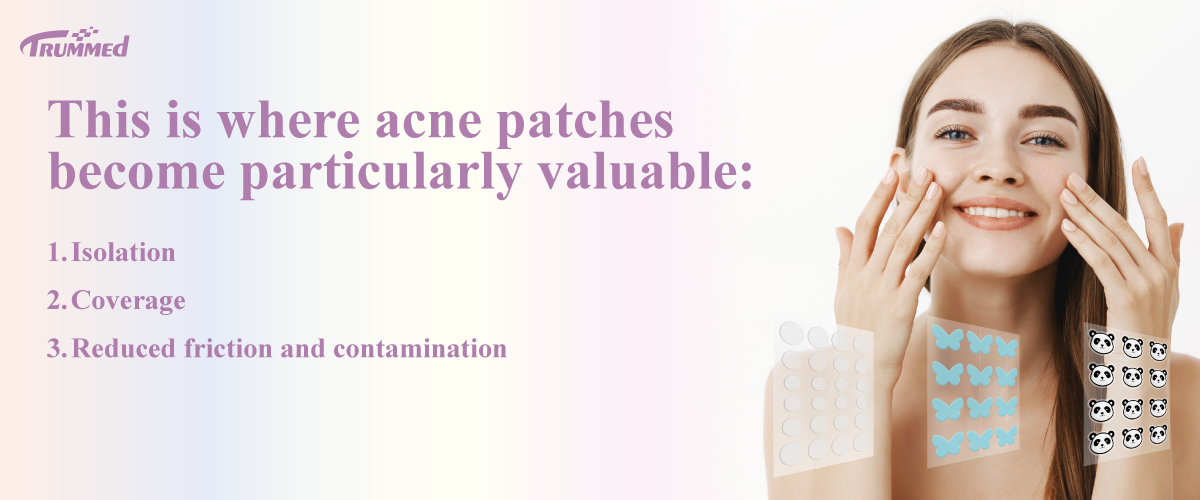
1. Isolation
2. Coverage
3. Reduced friction and contamination
“Covering” is not merely about hiding the pimple—
it is about preventing repeated contact that disrupts healing.
This is where acne patches become particularly valuable:
they create a physical barrier that reduces the chance of accidental touching, friction, and contamination.
3. Provide the Skin with a Stable Healing Environment
Skin healing does not require the area to be “as dry as possible.”
On the contrary, a stable, protected microenvironment is more conducive to inflammation resolution.
This principle is consistent with wound care:
1. Avoid frequent exposure to air and pollutants
2. Reduce excessive moisture loss
3. Lower external irritation on the lesion
When the skin is kept in a stable state,
the body is more likely to complete an orderly repair process rather than a chaotic one.
In practice, many people choose to use acne patches during the inflammatory stage because they help create a controlled microenvironment—
isolated, protected, and less disturbed.
4. Treat Acne as a “Micro Wound in the Process of Healing”
This is a crucial cognitive shift.
If you have a small wound, most people instinctively know:
1. Don’t touch it repeatedly
2. Don’t irritate it
3. Protect it and let it heal naturally
Acne during the inflammatory stage is essentially a micro skin injury.
In this context, the role of an acne patch becomes clear:
it is not a treatment per se,
but a protective layer.
When you unconsciously want to touch or squeeze, the patch acts as a barrier.
Conclusion
Acne itself is not the main problem.
The real risk is that when acne is still reversible,
over-intervention and repeated stimulation push it toward structural damage.
Scarring is difficult to reverse not because the skin is “too fragile,”
but because once the damage crosses a structural threshold,
the body can only repair by replacement, not true restoration.
Therefore, more important than finding stronger “repair methods” is:
not adding more damage while acne is still recoverable.
In this stage, the most rational approach is often not stronger medication,
but more stable protection—
such as using an acne patch to provide isolation and support a controlled healing environment.