
Joints are some of the most difficult areas to keep covered after an injury. Unlike flat areas of the body, knees, elbows, ankles, and fingers are constantly moving, stretching, bending, and rubbing against clothing or other surfaces.
So, what makes joint areas so challenging—and what should you look for when choosing a wound dressing?
1. Constant Movement Puts Stress on the Dressing
Every time you bend your knee or elbow, the skin around the joint stretches and folds.
This repeated movement creates mechanical stress between the skin, adhesive layer, and dressing material. If the dressing is too rigid, it may not move naturally with the skin, causing the edges to lift or the dressing to gradually loosen.
This is why flexibility and conformability are particularly important for wounds located around joints.
2. Friction and Moisture Can Affect Adhesion
Joint areas are exposed to frequent friction. Knee dressings may rub against clothing, ankle dressings can contact socks and shoes, while elbow and finger dressings experience repeated contact during daily activities.
Sweat and moisture can make the problem worse by interfering with adhesive performance.
For highly mobile areas, a dressing needs more than strong adhesion. Flexibility, breathability, conformability, and moisture management all contribute to better wearability.
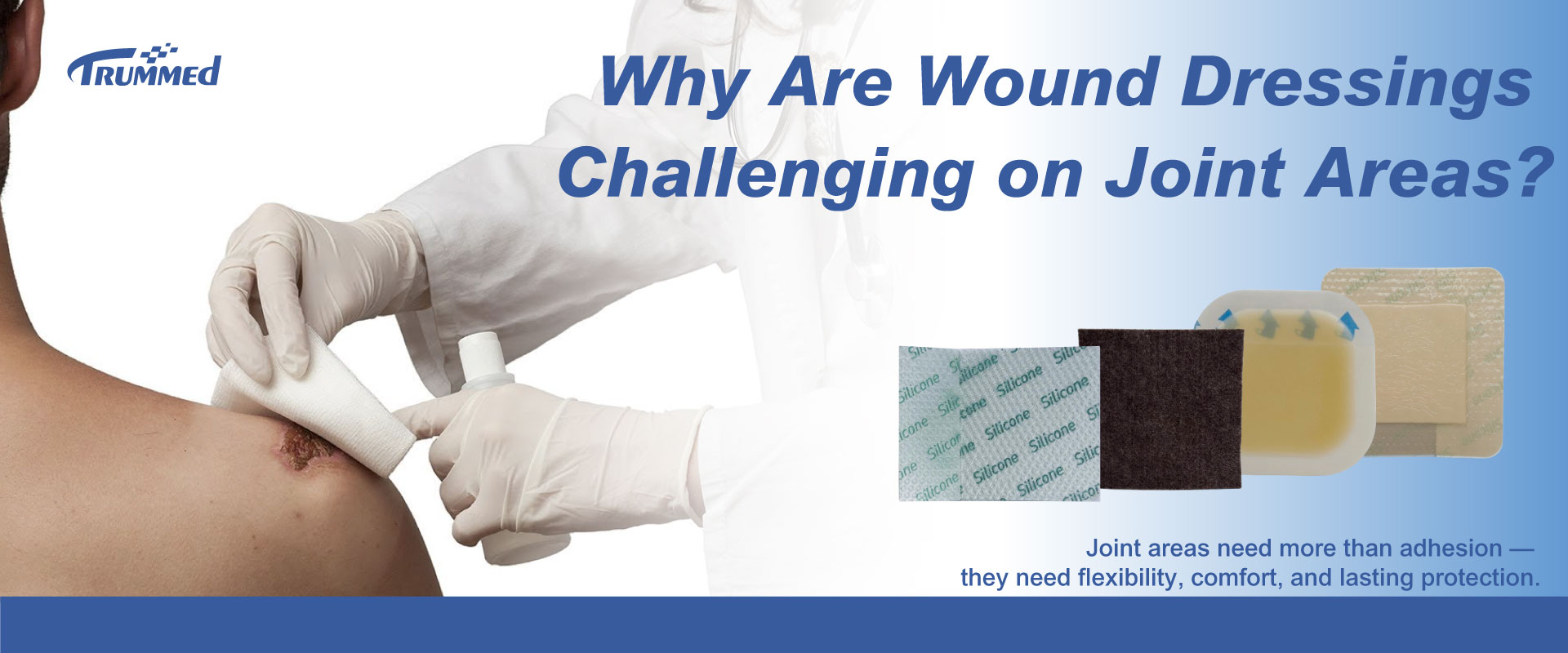
3. Which Wound Dressings Are Suitable for Joint Areas?
The right dressing depends on the wound type, exudate level, location, and expected amount of movement.
Hydrocolloid dressings can be a good option for low-to-moderately exuding superficial wounds, including certain abrasions and blisters.
For joint areas, a thin and flexible hydrocolloid dressing with good conformability is generally preferable to a thick, rigid design.
For wounds with higher levels of exudate, foam dressings provide greater fluid-handling capacity.
A flexible foam dressing with an appropriate adhesive border can be useful for wounds around knees, elbows, ankles, and other areas exposed to movement.
When gentle removal is important, silicone foam dressings can be a suitable choice.
Their gentle contact layer can help reduce trauma during dressing changes while allowing the dressing to conform to the wound area.
For wounds producing moderate to heavy exudate, alginate or gelling fiber dressings can help manage wound fluid.
These are generally used as primary dressings and may require a suitable secondary dressing or fixation method, particularly in highly mobile areas.
4. Stronger Adhesion Isn't Always the Answer
When a dressing repeatedly falls off, it is tempting to assume that the adhesive simply isn't strong enough.
But for joint areas, stronger adhesion alone isn't necessarily the solution. A dressing can have strong adhesive properties and still fail if its backing is too rigid or cannot accommodate skin movement.
The better approach is to consider the entire dressing system:
Adhesion + Flexibility + Conformability + Moisture Management + Protection
These characteristics work together to determine how well a dressing performs during everyday movement.
Choosing the Right Dressing for Moving Areas
For wounds located on knees, elbows, ankles, fingers, and other high-movement areas, look for dressings designed to conform to the body's contours.
For superficial, low-to-moderate exudate wounds, flexible hydrocolloid dressings can be a practical choice. For wounds requiring greater fluid absorption, flexible foam or silicone foam dressings may be more appropriate. For moderate-to-heavy exudate, gelling fiber or alginate dressings with suitable secondary fixation can provide better fluid management.
Ultimately, the best dressing is not simply the one with the strongest adhesive. It is the one that can stay in contact with the wound while adapting to the body's natural movement.