1. The Overlooked Mechanism Behind “Gentle” Products
Acne patches are widely positioned as gentle, non-invasive solutions for managing breakouts. In most cases, that positioning is accurate.
However, beneath this perception lies a less discussed mechanism:
the mechanical interaction between adhesive materials and the skin surface.
In clinical contexts, this type of interaction is associated with
medical adhesive-related skin injury (MARSI),
where repeated adhesion and removal can disrupt the outermost skin layer.
In consumer skincare, the same mechanism exists — but is rarely named or recognized.
2. Why the Risk Is Often Invisible in Acne Patches
Compared to traditional medical dressings, acne patches are inherently lower risk. Several design and usage factors reduce the visibility of adhesive-related effects:
· Small application size (spot treatment rather than full coverage)
· Short wear duration (typically under 12 hours)
· Hydrocolloid material behavior, which maintains a moist interface
· Lower peel-force adhesive systems, designed for easy removal
Together, these factors do not eliminate mechanical impact —
but they significantly reduce its intensity and frequency.
As a result, any minor skin response is often subtle and transient, making it less likely to be examined closely.
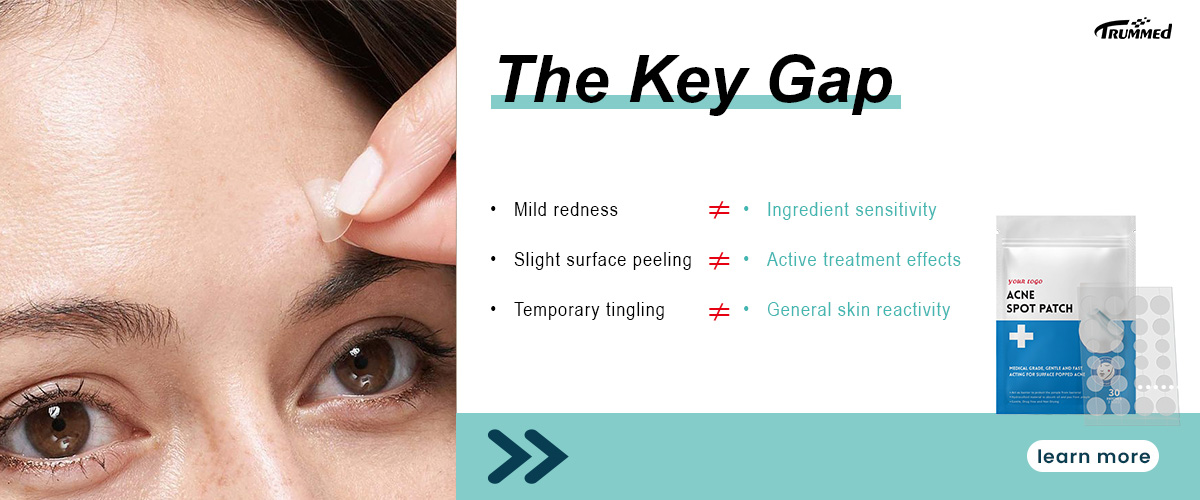
3. The Key Gap: Chemical vs. Mechanical Interpretation
When visible reactions do occur, they are rarely interpreted as mechanical.
Common observations include:
· Mild redness
· Slight surface peeling
· Temporary tingling
These are typically attributed to:
· Ingredient sensitivity
· Active treatment effects
· General skin reactivity
However, from a material–skin interaction perspective,
some of these responses may also relate to adhesion and removal dynamics, rather than formulation alone.
Not all skin reactions are chemical — some are mechanical.
This distinction is rarely made in consumer-facing discussions, which contributes to the lack of awareness.
4. When the Interaction Becomes More Noticeable
While acne patches are generally low-impact, certain conditions can make mechanical effects more apparent:
· Repeated application on the same area
· Compromised skin barrier (e.g., post-exfoliation or treatment)
· Higher adhesion strength or thicker coating layers
· Faster or more vertical removal techniques
In these scenarios, even a “gentle” adhesive system may produce
a more noticeable interaction with the stratum corneum.
5. A Subtle but Telling Observation
In some cases, users report mild redness or slight peeling after removing hydrocolloid patches — particularly when the application area is larger or the skin is thinner.
These reactions are often interpreted as sensitivity to ingredients. However, from a skin-interaction perspective, they can also be related to how adhesive materials interact with the outermost skin layer during removal.
Because these effects are usually subtle and short-lived, they are rarely identified as mechanical in nature.
6. What This Means for Adhesive and Product Design
From a product development standpoint, this highlights an important consideration:
Adhesive performance cannot be evaluated in isolation.
It is always shaped by the interaction between:
· Peel force (removal energy)
· Dwell time (duration of adhesion)
· Skin condition (oil level, hydration, barrier integrity)
· Application format (spot vs. large-area coverage)
For example:
· A peel force that performs well on oily skin may behave differently on thinner or drier areas
· Increased hydrocolloid absorption can soften the interface, but also change how the adhesive conforms to micro-textures
· Larger patch formats distribute stress differently during removal compared to small, discrete patches
In this context, “low peel” does not always translate directly to “low impact” —
especially across varying skin zones and usage patterns.
7. Conclusion: A Quiet Variable Worth Understanding
Acne patches are designed to be gentle — and in most applications, they are.
But the interaction between adhesive materials and skin is not entirely passive.
It is dynamic, context-dependent, and often overlooked.
The reason adhesive-related effects are rarely discussed is not because they do not exist,
but because they are:
· subtle
· short-lived
· and easily attributed to other causes
Understanding this layer does not change how acne patches are used —
but it provides a more complete view of how they perform.
And in product development, that distinction can make a meaningful difference.