In the daily care of ostomy patients, the selection of ostomy bags is crucial, and the non-woven fabric material used in these bags directly affects both the user experience and the effectiveness of care. High-quality non-woven fabrics can provide patients with comfort and safety guarantees; conversely, inferior ones may lead to a series of skin problems or usage troubles. So, how can we judge the quality of the non-woven fabric in ostomy bags?
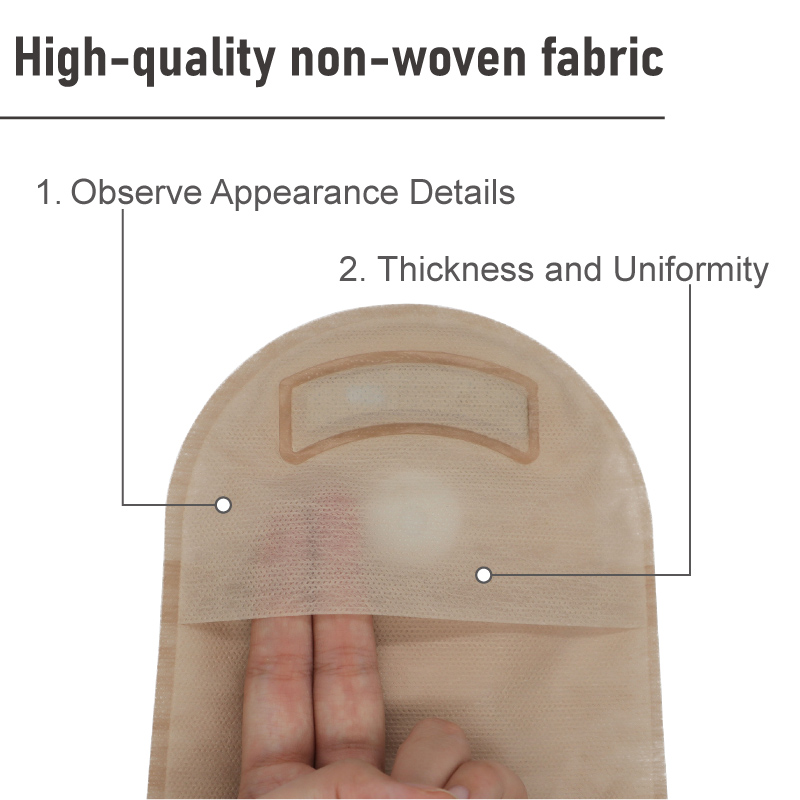
1) Observe Appearance Details
1.1 Check the Surface Flatness
High-quality non-woven fabric should have an even, fine surface without obvious wrinkles, particles, lint or damage.
If the surface is rough, has agglomerations or uneven fiber distribution, it may indicate poor material quality or rough production processes, which can easily cause skin friction and bacterial growth. The edge stitching should be flat and firm, without thread breakage or curling, to avoid skin irritation or leakage caused by rough edges.
1.2 Thickness and Uniformity
The non-woven fabric of ostomy bags usually needs a certain thickness to ensure support and leakproofness, but thicker is not necessarily better. The key is uniform thickness.
You can observe it against the light; if some parts are too thin or too thick, it may affect durability and protective effect.
2) Test Core Performance
2.1 Breathability
Breathability is a key indicator of the non-woven fabric used in ostomy bags, which directly affects skin comfort (preventing stuffiness and rashes).
Simple test: Bring the non-woven fabric close to your mouth and nose, then exhale to feel how smoothly the air passes through it. Alternatively, cover it over a cup filled with hot water and observe whether water vapor condenses quickly at the cup mouth (for materials with good breathability, the water vapor will pass through and dissipate more quickly).
High-quality non-woven fabrics mostly adopt a porous structure design, which is breathable but impermeable to liquids. This prevents leakage of excreta while reducing skin stuffiness.
2.2 Skin-friendliness and Softness
Touch the surface of the non-woven fabric with your hand.
High-quality materials should feel soft and smooth, without a stiff or itchy sensation. They should not pill or shed lint when rubbed against the skin, so as to avoid irritating the sensitive skin around the stoma (especially during long-term use).
You can stick the non-woven fabric on the inner side of your wrist and let it sit for a few minutes. If redness or itching occurs, the material may not be gentle enough (for example, it may contain irritating chemical additives).

2.3 Strength and Durability
Tensile test: Gently pull the non-woven fabric. High-quality materials should have certain elasticity and toughness, and be not easy to tear; after being released, they can basically return to their original shape without obvious deformation. If it breaks easily when pulled or deforms severely, the material may be sparse and lack strength, which is prone to damage and leakage. Abrasion resistance: Rub the surface repeatedly with fingers. Inferior non-woven fabrics may shed lint or pill, while high-quality ones are relatively wear-resistant and not easy to be damaged during long-term use.
2.4 Waterproof
High-quality non-woven fabrics have a waterproof function. This design can not only help block external moisture from the ostomy bag, but also reduce skin problems around the stoma (such as redness, swelling, infection, etc.) caused by a humid environment.
3) Check Product Certification
Checking whether the product has passed relevant medical device certifications is also very important.
Trummed Ostomy Bags are with CE certification, FDA registration, abd more.
Conclusion:
The non-woven fabric of high-quality ostomy bags needs to balance breathability (to avoid stuffiness), softness and skin-friendliness, sufficient strength, leakproofness and durability, and comply with medical device safety standards. When purchasing, priority should be given to good quality bramd, such as Trummed Medical, which have mature production processes and stricter material control, thus reducing the risk of use.