In the past, people often believed that keeping a wound dry and letting it scab was the best way to heal.
However, modern medical research completely overturned that idea.
In the 1960s, British surgeon George D. Winter discovered that wounds healed twice as fast in a moist environment compared to a dry one.
This finding gave rise to the core theory of modern wound care — the Moist Wound Healing Principle.
As the material that best realizes this principle, hydrocolloid has become a trusted choice in both clinical wound management and everyday skincare.
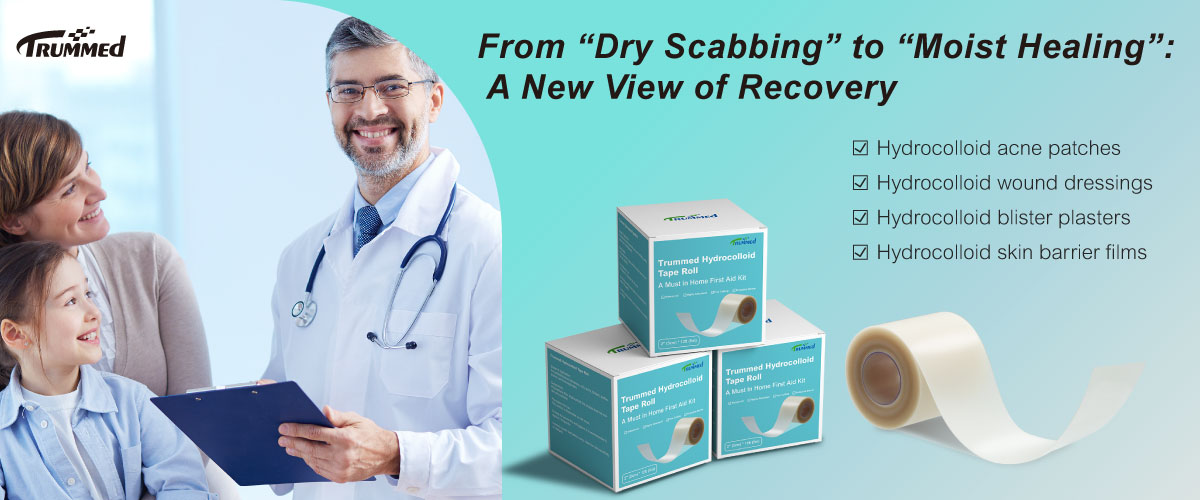
1. From “Dry Scabbing” to “Moist Healing”: A New View of Recovery
Traditional gauze leaves wounds exposed to air, leading to dryness and scab formation.
While a scab looks protective, it actually blocks new epithelial cells from migrating and repairing the skin.
Hydrocolloid, on the other hand, absorbs exudate and forms a soft gel layer, creating an ideal moist, breathable, and sealed environment.
In this condition, cells can migrate freely, growth factors remain active, and tissue heals faster — often with fewer scars and less pain.
2. The Science Behind the “Ideal Microenvironment”
When hydrocolloid interacts with wound exudate, it forms a semi-occlusive gel layer — not just moist, but a dynamic micro-ecosystem.
This environment maintains:
· Optimal moisture – prevents scabbing and supports keratinocyte migration.
· Stable temperature (~37°C) – promotes blood flow and enzyme activity.
· Mildly acidic pH (~5.5) – helps inhibit bacterial growth and supports barrier recovery.
This closed, balanced microenvironment keeps the wound in the most favorable condition for tissue regeneration.
3. How Cells and Growth Factors Respond
Within this moist environment:
· Keratinocytes move more easily to close the wound surface.
· Fibroblasts produce more collagen and extracellular matrix.
· Growth factors (EGF, PDGF, etc.) stay active longer, avoiding oxidation or degradation.
· Inflammatory cells are regulated, reducing swelling and pain.
Together, these cellular responses form the biological foundation of faster, smoother healing.
4. The “Smart” Absorption and Moisture Control Mechanism
Hydrocolloid’s key components — such as CMC (carboxymethyl cellulose), gelatin, and pectin — possess ion-exchange and hydrophilic swelling properties.
As they absorb fluid, they swell into a transparent gel, with visible changes in thickness or color that indicate absorption progress.
The multilayer structure also regulates moisture vapor transmission rate (MVTR), keeping the wound moist but not overhydrated.
This “intelligent moisture balance” is what sets hydrocolloid apart from ordinary adhesive patches.
5. From Clinics to Daily Care: The Versatility of Hydrocolloid
Thanks to its biocompatibility and precise moisture control, hydrocolloid technology is now used in multiple applications:
· Wound dressings and hydrocolloid rolls – for surgical or chronic wound care.
· Acne patches – to absorb pus, isolate bacteria, and calm inflammation.
· Blister or anti-friction patches – to prevent skin breakdown from rubbing.
· Skin barrier films – to protect peristomal or catheterized skin areas.

6. TRUMMED Hydrocolloid Roll: The Core Material Behind Moist Healing
As a professional medical-grade hydrocolloid manufacturer, TRUMMED produces Hydrocolloid Rolls that serve as the base material for various hydrocolloid products, including:
· Hydrocolloid acne patches
· Hydrocolloid blister plasters
· Hydrocolloid wound dressings
· Hydrocolloid skin barrier films
Each TRUMMED Hydrocolloid Roll consists of a three-layer structure:
PET film + Hydrocolloid coating + Protective film,ensuring excellent sealing, flexibility, and consistent absorption performance.
Depending on design and film materials, TRUMMED offers several roll types for acne patch production:
· Transparent Hydrocolloid Roll – for invisible, clear acne patches.
· Printed Hydrocolloid Roll – for patterned or decorative acne patches.
· Glitter Hydrocolloid Roll – for sparkling, star-like patch designs.
· Glow-in-the-Dark Hydrocolloid Roll – for creative night-glow acne patches.
Each type is based on the same moist healing science, combining clinical-grade care with creative visual design — bringing together functionality, comfort, and aesthetic appeal.
7. Conclusion: The Science Doctors Trust
Doctors rely on hydrocolloid not merely because it absorbs fluid or reduces pain,but because it represents a more advanced approach to healing —supporting the body’s natural regenerative process rather than forcing it.
From professional wound care to daily skincare patches,TRUMMED carries the same commitment to science —using hydrocolloid’s moist healing principle to make skin recovery faster, gentler, and more natural.